Download Ebook Practical Object-Oriented Design: An Agile Primer Using Ruby (2nd Edition)
Reviewing a publication Practical Object-Oriented Design: An Agile Primer Using Ruby (2nd Edition) is kind of very easy task to do each time you want. Also reading every time you want, this task will not disrupt your other tasks; lots of people frequently review the e-books Practical Object-Oriented Design: An Agile Primer Using Ruby (2nd Edition) when they are having the spare time. Just what regarding you? Just what do you do when having the leisure? Do not you spend for useless points? This is why you have to get guide Practical Object-Oriented Design: An Agile Primer Using Ruby (2nd Edition) and also aim to have reading behavior. Reviewing this publication Practical Object-Oriented Design: An Agile Primer Using Ruby (2nd Edition) will not make you ineffective. It will give a lot more benefits.
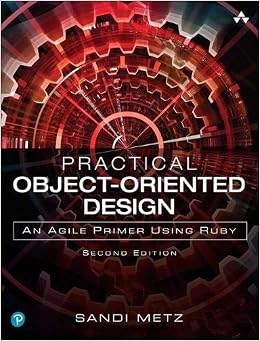
Practical Object-Oriented Design: An Agile Primer Using Ruby (2nd Edition)

Download Ebook Practical Object-Oriented Design: An Agile Primer Using Ruby (2nd Edition)
In suiting the new upgraded book launched, we come to you. We are the on-line site that constantly offers a very excellent method, fantastic term, and also excellent listings of the collections books from many countries. Reserve as a way to spread out the information and also information regarding the life, social, sciences, religious beliefs, many others holds an extremely important regulation. Book could not as the fashion when they run out date, they will certainly operate as nothing.
When having free time, what should you do? Only resting or sitting in the house? Full your spare time by analysis. Start from now, you time should be valuable. One to extend that can be reading material; this is it Practical Object-Oriented Design: An Agile Primer Using Ruby (2nd Edition) This book is supplied not only for being the product reading. You understand, from seeing the title and also the name of author, you have to recognize how the top quality of this book. Even the author and also title are not the one that makes a decision the book readies or not, you can compare t with the experience and also knowledge that the author has.
When someone attempts to read the Practical Object-Oriented Design: An Agile Primer Using Ruby (2nd Edition), it will imply that he or she has actually started something new, the brand-new knowledge. So, you require likewise to be among them that can acquire all generosity of reading this publication. As recognized, analysis is taken into consideration as one requirement to do be everybody. If you believe that analysis has to be done just by the trainees, that's absolutely wrong. You could face the life fell short.
When you actually require it as your resource, you could locate it now and also here, by locating the link, you could visit it as well as begin to get it by saving in your own computer tool or relocate to other device. By obtaining the link, you will obtain that the soft documents of Practical Object-Oriented Design: An Agile Primer Using Ruby (2nd Edition) is truly suggested to be one part of your hobbies. It's clear and also great sufficient to see you really feel so incredible to get the book to review.
Review
Praise for the first edition of Practical Object-Oriented Design in Ruby “Meticulously pragmatic and exquisitely articulate, Practical Object Oriented Design in Ruby makes otherwise elusive knowledge available to an audience which desperately needs it. The prescriptions are appropriate both as rules for novices and as guidelines for experienced professionals.” —Katrina Owen, Creator, Exercism “I do believe this will be the most important Ruby book of 2012. Not only is the book 100% on-point, Sandi has an easy writing style with lots of great analogies that drive every point home.” —Avdi Grimm, author of Exceptional Ruby and Objects on Rails “While Ruby is an object-oriented language, little time is spent in the documentation on what OO truly means or how it should direct the way we build programs. Here Metz brings it to the fore, covering most of the key principles of OO development and design in an engaging, easy-to-understand manner. This is a must for any respectable Ruby bookshelf.” —Peter Cooper, editor, Ruby Weekly “So good, I couldn’t put it down! This is a must-read for anyone wanting to do object-oriented programming in any language, not to mention it has completely changed the way I approach testing.” —Charles Max Wood, Ruby Rogues Podcast co-host and CEO of Devchat.tv “Distilling scary OO design practices with clear-cut examples and explanations makes this a book for novices and experts alike. It is well worth the study by anyone interested in OO design being done right and ‘light.’ I thoroughly enjoyed this book.” —Manuel Pais, DevOps and Continuous Delivery Consultant, Independent “If you call yourself a Ruby programmer, you should read this book. It’s jam-packed with great nuggets of practical advice and coding techniques that you can start applying immediately in your projects.” —Ylan Segal, San Diego Ruby User Group “This is the best OO book I’ve ever read. It’s short, sweet, but potent. It slowly moves from simple techniques to more advanced, each example improving on the last. The ideas it presents are useful not just in Ruby but in static languages like C# too. Highly recommended!” —Kevin Berridge, software engineering manager, Pointe Blank Solutions, and organizer, Burning River Developers Meetup “This is the best programming book I’ve read in ages. Sandi talks about basic principles, but these are things we’re probably still doing wrong and she shows us why and how. The book has the perfect mix of code, diagrams, and words. I can’t recommend it enough and if you’re serious about being a better programmer, you’ll read it and agree. —Derick Hitchcock, software engineer, Cisco “Metz’s take on the subject is rooted strongly in theory, but the explanation always stays grounded in real world concerns, which helped me to internalize it. The book is clear and concise, yet achieves a tone that is more friendly than terse.” —Alex Strasheim, network administrator, Ensemble Travel Group “Whether you’re just getting started in your software development career, or you’ve been coding for years (like I have), it’s likely that you’ll learn a lot from Ms. Metz’s book. She does a fantastic job of explaining the whys of well-designed software along with the hows.” —Gabe Hollombe, software craftsman, avantbard.com
Read more
About the Author
Sandi Metz is a programmer, teacher, author, and sometime consultant. In the past 30+ years she has written innumerable applications and creates practical solutions that produce working software that is easy to change. She has spoken about object-oriented design and refactoring at international Ruby conferences since 2009.
Read more
Product details
Paperback: 288 pages
Publisher: Addison-Wesley Professional; 2 edition (September 1, 2018)
Language: English
ISBN-10: 9780134456478
ISBN-13: 978-0134456478
ASIN: 0134456475
Product Dimensions:
7 x 0.8 x 9.1 inches
Shipping Weight: 1.1 pounds (View shipping rates and policies)
Average Customer Review:
4.7 out of 5 stars
184 customer reviews
Amazon Best Sellers Rank:
#25,924 in Books (See Top 100 in Books)
My coworkers tended to describe this book as the New Testament. Working as a Rails Developer, I had heard Sandi Metz mentioned in passing at least a dozen times before I started reading this book. This book was offered to me with a very high set of expectations, and I do not feel that those expectations were entirely merited.My reading experience suffered from three key aspects:(1) Like any author, Metz had to choose some kind of raw material for her examples. She chose... biking (ahem, cycling). This carries a lot of baggage on the West Coast—something akin to choosing horseback riding or fine wines. The decision to use cycling as the cultural center of the book left a really bitter taste in my mouth. The examples felt unapproachable and niche. It's easy to think about the Inheritance pattern that attends the animal, the dog and the golden retriever. It is more than a little self absorbed to think that most of your readers are going to get out of bed for discussions about tape color, recumbent mountain bikes and chain sizes.(2) Metz uses sentence structure that feels overly complicated. The comparison that comes to mind is Aristotle. There were a large number of sentences that I needed to reread. I can only imagine what a slog this book would be for an ESL reader.(3) The spacing and visual style of the code examples were unattractive and unapproachable. This book is six years old but looks like it was written in 1992.The wisdom in this book is absolutely worthy of a 5-star review and I am a stronger engineer for having read it. For engineers working with Ruby, I am not sure that there is a better resource for learning OOP design patterns. That said, this is not the Bible of OOP for developers in all languages. If you are a Swift or Kotlin or C++ developer, look elsewhere.
While the industry moves more towards Functional Programming Paradigms and away from Object-Oriented Thinking, Sandi Metz's book, Practical Object-Oriented Design in Ruby, published in 2012, still stands the test of time with OOP best-practices. It is truly a practitioner's guide to Navigating Changing Requirements and being truly Agile.The book addresses OOP Anti-patterns and the Reader is taken through iterative steps in evolving the Example Applications throughout the chapters. In some ways, it can be likened to thinking in more of a 'Data-Modeling' Manner, though adapted for OOP instead of Relational Databases.If you work in Software, you should read or re-read this book. The author also has a more recent book available through her web site, which is of similar quality though has more of a Programming or Puzzle-like Feel.
I have programmed in Ruby for a number of years now and still found this book of value. I would not recommend it for absolute beginners because it assumes knowledge of the language, though you will learn general principles. I would recommend it for anyone wanting to get a better grasp of writing good object oriented code, especially in Ruby. I found it helpful to think of Messages sent instead of just the class hierarchy.
I hate bronchitis! Reading "Practical Object-Oriented Design in Ruby" was a blast. Reading it while ill was frustrating! Lots of thought provoking ideas written in an easy to read style. I kept falling asleep due to sickness and my brain kept yelling "This is cool! Stay awake!" Still, Sandi achieved her goal even through my fog of exhaustion; I now see objects very differently and will happily refactor my code to make it better.The only real ding to the book is Chapter 8's references to Enumerable and Forwardable. Everything else in the book was either easy to read or well explained. These two characters seem to have slipped in without fanfare or explanation. I don't understand them and thus probably missed some of the book's goodness. Perhaps I'll get it later. I still rate this book a 5 star buy!
This is my favorite tech read so far this year. It takes a straight-forward approach to writing code that you won't hate yourself for a day or month or year later.The term "design" in the title is not referring to making wild speculative guesses about the future and planning for any number of contingencies, it is about arranging the code so that it is understandable, and to minimize cost and pain.There is a focus on designing the communication between objects as much as focusing on the structure of the objects themselves, which I found to be extremely interesting. This discussion helped clarify a lot of thoughts and ideas about abstractions and where responsibilities belong, as well as the directions of dependencies -- things that had been rattling around in my brain for a while but that I had trouble applying in the real world. Reading this let me put all these pieces together (and then some) into a coherent whole. Or at least a coherent seed of a whole.The code examples are simple, but the author manages to wrangle some serious dramatic tension out of every line of code, and they illustrate the concepts covered well enough that I was able to make the leap to applying the concepts in much more complex code bases.The chapter on testing was sublime. It took an immensely practical approach to which methods to test and which tests to write in order to avoid duplication and brittleness in both tests and designs.I also appreciated that none of the discussions were about any sort of moral superiority. The discussions were about getting things done. The argument for arranging code nicely wasn't about aesthetics or professional duty, but rather about lowering cost and allowing you to make changes without causing expensive outages and making people frustrated.Soap boxes? Sure. High horses? Nowhere in sight.Note: I read a pre-release version of the book. I did not know the author at the time, but sent her quite a lot of feedback, which led to several conversations to clarify. When I waxed enthusiastic about the contents, she asked if she could forward this to the publisher, and a quote ended up in the paper copy.
Practical Object-Oriented Design: An Agile Primer Using Ruby (2nd Edition) PDF
Practical Object-Oriented Design: An Agile Primer Using Ruby (2nd Edition) EPub
Practical Object-Oriented Design: An Agile Primer Using Ruby (2nd Edition) Doc
Practical Object-Oriented Design: An Agile Primer Using Ruby (2nd Edition) iBooks
Practical Object-Oriented Design: An Agile Primer Using Ruby (2nd Edition) rtf
Practical Object-Oriented Design: An Agile Primer Using Ruby (2nd Edition) Mobipocket
Practical Object-Oriented Design: An Agile Primer Using Ruby (2nd Edition) Kindle
Practical Object-Oriented Design: An Agile Primer Using Ruby (2nd Edition) PDF
Practical Object-Oriented Design: An Agile Primer Using Ruby (2nd Edition) PDF
Practical Object-Oriented Design: An Agile Primer Using Ruby (2nd Edition) PDF
Practical Object-Oriented Design: An Agile Primer Using Ruby (2nd Edition) PDF

This post was written by: Author Name
Your description comes here!

Posting Komentar